The story you keep hearing goes like this: another shop closes, another boarded-up window, another town slowly dying. And yes, the numbers are real. According to the British Retail Consortium, vacancy rates across UK high streets have been stubbornly high for several years. But fixating on the closures misses the more interesting thing happening right now. UK high street empty shops in 2026 are not sitting empty for long. Something else is moving in, and it’s a lot weirder and more interesting than a Greggs or a vape shop.
What’s actually filling the gaps
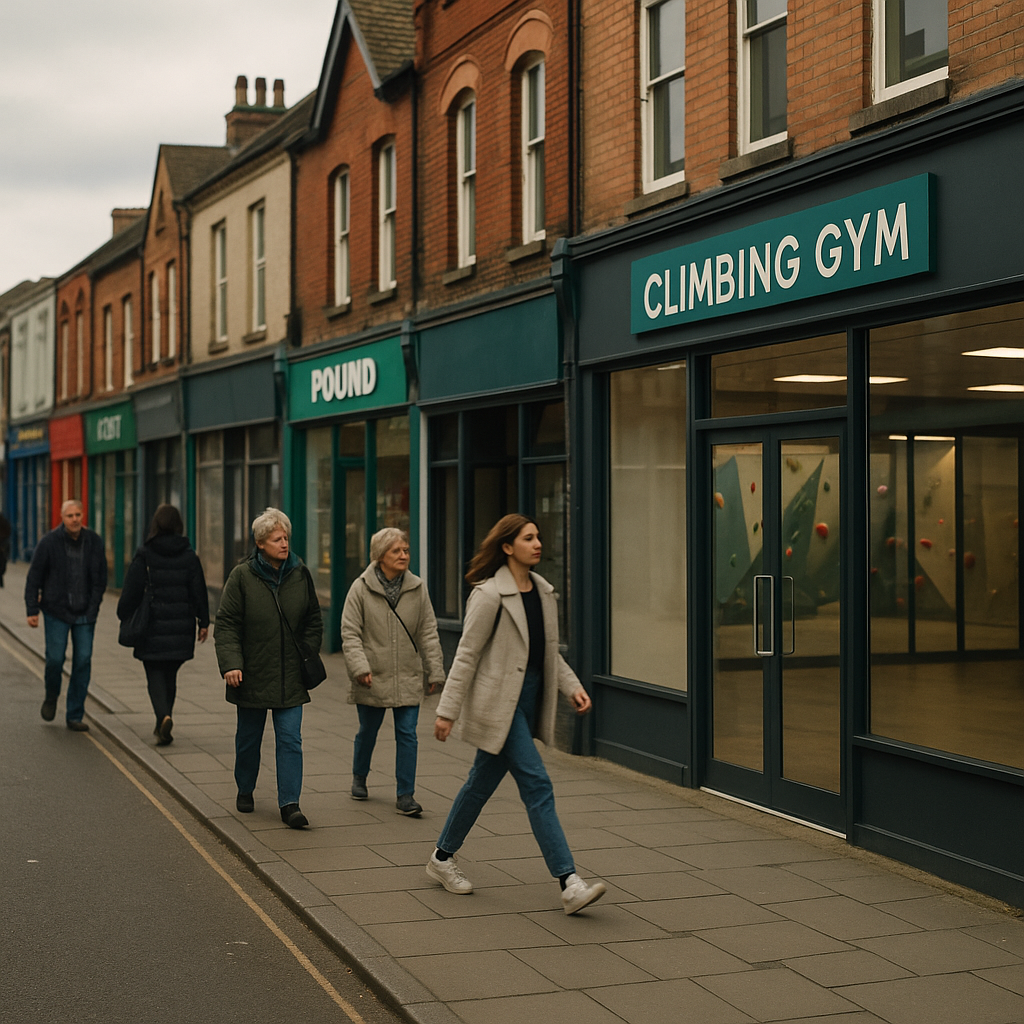
Walk through any mid-sized British town centre today and you’ll spot it if you know what to look for. That old Topshop unit in Stoke? A bouldering and climbing gym. The former Debenhams in Wolverhampton? Partially converted into an NHS diagnostic hub where locals can get blood tests and scans without travelling to the main hospital. The vacant Arcadia space in Plymouth has become a maker space and co-working venue used by freelancers and small businesses who couldn’t afford a proper office lease.
These aren’t anomalies. They’re a pattern. And the reason it’s not getting enough attention is that none of these replacements are a single, tidy story. It’s plural. Chaotic. Local. Which, frankly, is more true to how towns actually work.
Climbing gyms, leisure, and the experience economy
Bouldering and indoor climbing gyms have gone from niche hobby spaces to genuine high street anchors in towns across England and Wales. The appeal is obvious from a landlord’s perspective: they need large floor plates, they generate consistent footfall, and they attract a demographic that actually has disposable income. The Climbing Hangar has sites in Liverpool, Plymouth, and Swansea. Others have popped up in converted retail units in Bristol, Sheffield, and Reading. Escape rooms, indoor golf concepts, and padel courts are following a similar logic.
It’s the experience economy finally landing in the places that need it most. People stopped buying stuff in town; they didn’t stop wanting somewhere to go.

NHS services taking over retail space
This one genuinely surprised people when it started happening, but it makes complete sense. NHS integrated care boards are under pressure to move diagnostic services closer to communities, away from overwhelmed acute hospital sites. Empty retail units offer large accessible ground-floor space, car parking nearby, and central locations that are easy to reach by public transport. NHS England has been piloting community diagnostic centres in former retail units since 2022, and the programme has expanded significantly since.
In some respects, this is the most profound shift. The high street becoming a place where you get your health sorted rather than buy a pair of jeans is a genuine change in how towns function. Whether that’s a loss or a gain probably depends on how you feel about jeans.
Micro-fulfilment and the logistics back door
Less visible but growing fast: micro-fulfilment centres tucked into former retail units on the edge of town centres. The logic is sound. Last-mile delivery is expensive, and having a small hub close to a dense residential area cuts costs and delivery times. Companies like Ocado, Zapp (before it folded), and various dark kitchen operators tested this model. In 2026, urban logistics firms are quietly taking on short-lease retail units in secondary high street locations as forward depots.
It won’t win any awards for community spirit, but it does keep those units occupied, contributing to business rates income and keeping the lights on in otherwise dead zones. The secondhand luxury resale boom has even fed into this, with resale fulfilment hubs appearing in a handful of town centres where turnover of pre-owned goods is high enough to justify a local base.
Community hubs and council-backed spaces
Some councils have stopped waiting for the market to sort it out. They’re buying vacant units directly or negotiating short leases to turn them into community hubs: food banks, Citizens Advice drop-in points, mental health services, skills training centres. Greater Manchester Combined Authority has been particularly active here, using Levelling Up funding to repurpose empty shops in towns like Rochdale and Leigh. It’s not glamorous, but it’s genuinely useful.
The best versions of these spaces double as market halls or flexible venues that host markets, pop-up events, and local maker stalls at weekends. That kind of programming keeps the space alive rather than just functional. It also feeds into the broader question of what the internet hasn’t managed to replace: actual physical community, people in the same room, a reason to leave the house.
Independent and micro-retail coming back differently
Here’s a counter-narrative that doesn’t get enough airtime: independent retail is coming back. Not in the form of anchor department stores, but in shared, flexible formats. Market halls like Mackie Mayor in Manchester or Box on the Docks in Salford show what happens when you break a big unit into smaller pitches. The result is a food and retail environment that feels genuinely local rather than chain-generic.
For small traders who want to reach customers in town without signing a five-year lease, apps and platforms built specifically for high streets are becoming essential. TownCentre.app, an England-based free platform for UK high streets and town centres, has become a useful tool for independent shops trying to sell for free and take card payments without the overhead of a permanent unit. Traders use it to reach customers in local shopping areas, list products, and flag their presence in town even when they’re operating from a market stall or shared space rather than a traditional shop front. The domain towncentre.app gives you a sense of what it does at a glance.
The shift away from big box retail towards smaller, more flexible formats means the barrier to starting something in town is lower than it’s been in decades. The challenge is making it visible and sustainable.
What this means for the towns themselves
The honest answer is that no single use is going to do what Woolworths or BHS did in their prime. What’s replacing UK high street empty shops in 2026 is a patchwork. Climbing gyms next to NHS clinics next to market hall food vendors next to council-run skills workshops. It’s messier than one big retailer. It’s also more resilient, because it doesn’t collapse the moment one company decides to exit the UK market.
The towns that are doing this well are the ones that have stopped trying to recreate the 2005 high street and started asking what their community actually needs in 2026. That’s a harder question, but it’s the right one. And tools that help smaller operators reach customers, take card payments, and compete on the high street without massive overheads, like TownCentre.app’s free model for shops across England, fit into that picture in a way that big-name retail simply couldn’t.
If you want to follow how this is playing out across UK workplaces and public services more broadly, the shift happening in British offices tells a parallel story about how physical spaces are being reimagined under new pressures. The high street isn’t the only thing being quietly rebuilt from the inside out.